
Why Multi-Cloud Strategy Fails in Large Enterprises
This article explains why multi-cloud fails enterprises when governance, cost control, and operational alignment are not addressed early.
In large organizations, multi-cloud fails enterprises most often due to fragmented ownership and inconsistent operating models.
A multi-cloud strategy promises flexibility, resilience, and vendor independence. Yet in practice, many organizations discover that their multi-cloud initiatives underperform or collapse under complexity. Understanding why multi-cloud strategy fails in large enterprises is critical before scaling investments across multiple cloud platforms.
For enterprise leaders, multi-cloud is not just a technical architecture—it is an operating model. When execution lacks governance, clarity, and alignment, the strategy introduces more risk than value.
Lack of a Clear Business-Driven Cloud Strategy
One of the primary reasons why multi-cloud strategy fails in large enterprises is the absence of a business-driven rationale. Many organizations adopt multiple cloud providers to avoid vendor lock-in or follow market trends, without defining clear use cases for each platform.
Without strategic intent, multi-cloud environments become fragmented. Teams deploy workloads inconsistently, leading to duplicated services, rising costs, and operational confusion rather than agility.

Operational Complexity and Tool Sprawl
Each cloud provider introduces its own tooling, billing models, security controls, and operational processes. As enterprises expand across multiple clouds, managing these differences becomes increasingly complex.
This operational sprawl is a major reason why multi-cloud strategy fails in large enterprises. Instead of gaining flexibility, organizations struggle with monitoring gaps, inconsistent performance management, and slower incident response across platforms.
Inconsistent Security and Compliance Controls
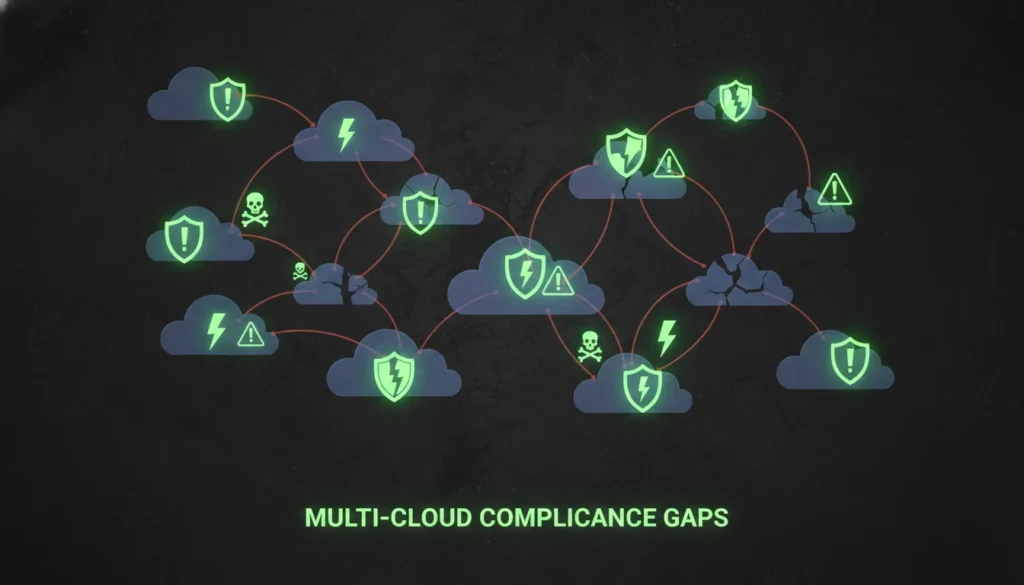
Security posture often weakens in poorly governed multi-cloud environments. Different providers enforce security controls differently, making it difficult to maintain consistent identity management, access policies, and compliance standards.
Large enterprises operating in regulated industries face heightened risk when security policies are not unified. This inconsistency is a critical reason why multi-cloud strategy fails in large enterprises, especially at scale.
Hidden Cost Escalation Across Clouds
While multi-cloud is often justified as a cost-optimization approach, it frequently produces the opposite result. Disparate pricing models, data egress fees, and duplicated infrastructure drive unexpected spending.
Without centralized cost governance and visibility, finance and IT teams lose control over cloud budgets. Cost inefficiency is one of the most underestimated reasons why multi-cloud strategy fails in large enterprises.
Skills Gaps and Organizational Misalignment
Multi-cloud environments demand advanced skills across multiple platforms. However, most enterprise teams are deeply experienced in only one or two cloud ecosystems.
This skills gap leads to inconsistent architecture, misconfigurations, and reliance on external vendors. Organizational readiness—or the lack of it—is a core reason why multi-cloud strategy fails in large enterprises over time.
Absence of Centralized Governance and Ownership
Successful multi-cloud adoption requires clear ownership and governance structures. In many large enterprises, cloud decisions are decentralized without guardrails.
When no single team owns architecture standards, security policies, and cost controls, multi-cloud environments drift. This lack of accountability is often the final factor in why multi-cloud strategy fails in large enterprises.
Why Multi-Cloud Complexity Scales Faster Than Value
In large enterprises, complexity grows exponentially as more cloud platforms are introduced. Each provider adds unique architectures, services, and operational models, increasing coordination overhead across teams. This imbalance between complexity and value is a major reason why multi-cloud strategy fails in large enterprises.
Without standardization and centralized oversight, enterprises experience slower delivery cycles, inconsistent service quality, and higher operational risk. Over time, the cost of managing complexity outweighs the flexibility multi-cloud was meant to provide.
Conclusion: Making Multi-Cloud Work at Enterprise Scale
Multi-cloud itself is not flawed—but unmanaged multi-cloud is. Understanding why multi-cloud strategy fails in large enterprises allows leaders to address governance, security, cost control, and organizational readiness before problems scale.
Learn how DB Soft Tech helps enterprises design controlled, scalable cloud strategies on our About Us page.
Planning a multi-cloud strategy that delivers flexibility without chaos? Contact DB Soft Tech to build a secure, enterprise-ready cloud operating model.