AI agents replacing automation marks a major shift in how enterprises design intelligent systems. Traditional automation relied on predefined rules and static workflows. AI agents introduce autonomy, reasoning, and adaptability, allowing systems to operate dynamically in complex and changing environments.
As enterprises scale digital operations, rule-based automation increasingly fails to keep pace with real-world complexity. AI agents address this gap by combining decision-making, learning, and execution within a single intelligent framework.
From Rule-Based Automation to Intelligent Agents
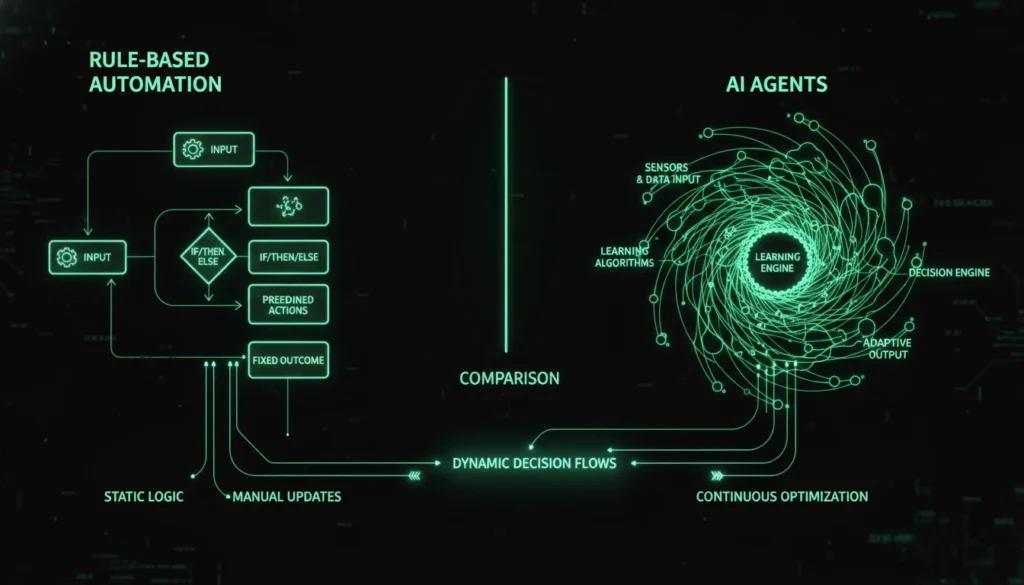
Traditional automation excels at repetitive, predictable tasks. However, it breaks down when processes involve ambiguity, exceptions, or changing conditions. Every variation requires manual reconfiguration.
AI agents replace this rigidity with goal-driven behavior. Instead of following fixed scripts, agents understand objectives, evaluate context, and decide how to act. This evolution explains why AI agents replacing automation is becoming a strategic priority for modern enterprises.
Continuous Decision-Making at Scale
AI agents operate continuously rather than sequentially. They monitor systems, interpret signals, and take action without waiting for predefined triggers. This allows enterprises to respond in real time to operational changes.
In contrast, traditional automation requires explicit rules for every scenario. AI agents learn from outcomes and adjust behavior automatically, making systems more resilient and scalable.
Autonomous Problem Solving Across Systems
One of the most powerful advantages of AI agents replacing automation is autonomous problem solving. Agents can coordinate across applications, APIs, and data sources to complete multi-step tasks.
For example, an AI agent can detect a supply-chain disruption, evaluate alternatives, negotiate inventory allocation, and update enterprise systems without human intervention.
Learning and Adaptation Over Time
Traditional automation does not improve unless humans redesign workflows. AI agents continuously learn from feedback, outcomes, and new data.
This adaptive capability allows enterprises to deploy systems that become more effective over time rather than degrading as conditions change.
Human-in-the-Loop Control and Trust
AI agents do not eliminate human oversight. Instead, they elevate it. Humans define objectives, constraints, and risk thresholds while agents execute within those boundaries.
This human-in-the-loop model ensures accountability, compliance, and ethical alignment—areas where traditional automation often lacks transparency.
Enterprise Use Cases Accelerating Adoption
AI agents are rapidly replacing automation in IT operations, cybersecurity response, customer support orchestration, financial reconciliation, and business process management.
According to McKinsey Digital, autonomous AI systems are becoming core to enterprise productivity and operational resilience.
Why This Shift Is Happening Now
Advances in large language models, reasoning engines, and system integration have made AI agents practical at enterprise scale. At the same time, business complexity has exceeded the limits of static automation.
This convergence explains why AI agents replacing automation is no longer experimental—it is inevitable.
Why Traditional Automation Can No Longer Scale
Traditional automation depends on static rules and predefined workflows that break under real-world complexity. As enterprises expand across systems, data sources, and customer touchpoints, maintaining rule-based automation becomes costly and fragile.
This limitation explains why AI agents are replacing traditional automation as the preferred model for scalable, intelligent enterprise operations.
Conclusion: Automation Evolves Into Intelligence
Why AI agents are replacing traditional automation comes down to one reality: enterprises need systems that can think, adapt, and act autonomously. AI agents deliver flexibility, scalability, and intelligence that rule-based automation cannot.
Learn how DB Soft Tech designs agent-driven enterprise platforms on our About Us page.
Ready to move beyond automation into intelligent operations? Contact DB Soft Tech to build scalable AI agent architectures for your enterprise.