Introduction
Aligning IT strategy with business goals in 2026 has become a critical priority for enterprises navigating rapid digital transformation. Technology is no longer a back-office function—it is a core driver of revenue, scalability, customer experience, and competitive advantage. Organizations that fail to align their IT initiatives with business objectives risk inefficiencies, wasted investments, and slower growth.
In 2026, successful enterprises treat IT strategy as a business enabler, ensuring every technology decision directly supports measurable outcomes such as operational efficiency, innovation, and market expansion.
Why IT Strategy Alignment Matters More in 2026
In highly competitive digital markets, misaligned IT initiatives often lead to duplicated tools, rising operational costs, and slow execution. By aligning IT strategy with business goals, organizations ensure technology investments directly support growth priorities, improve cross-team efficiency, and enable faster time-to-market for new products and services.
The pace of technological change continues to accelerate. Cloud platforms, artificial intelligence, automation, and data-driven systems now influence nearly every business function. Without strategic alignment, IT investments can become fragmented and disconnected from business priorities.
When organizations align IT strategy with business goals, they gain clarity on where to invest, how to scale systems, and which technologies deliver the highest return. This alignment enables leadership teams to move faster, reduce risk, and maintain agility in competitive markets.
Connecting Business Objectives to Technology Roadmaps
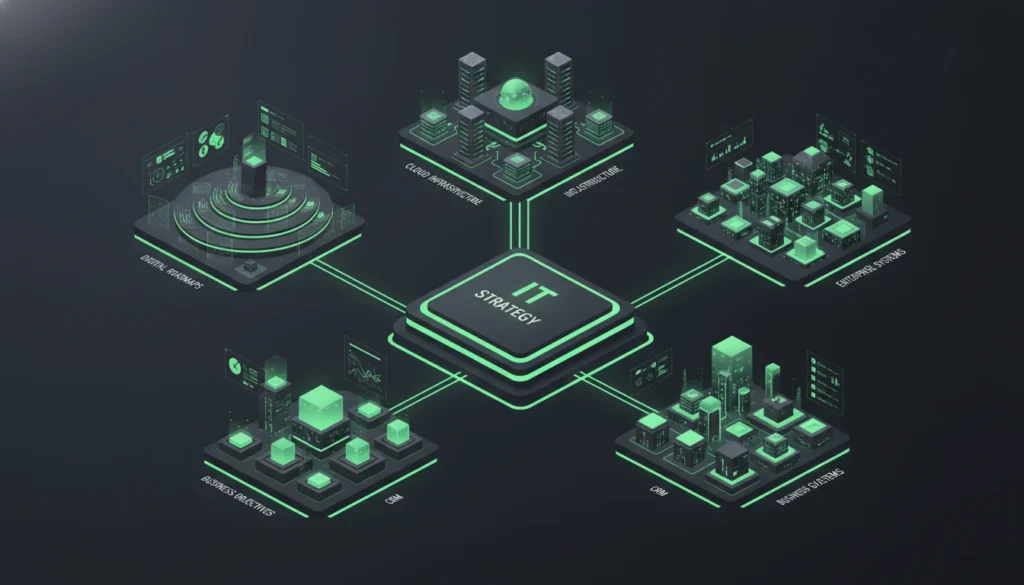
Effective alignment begins with clearly defined business objectives. Whether the goal is expanding into new markets, improving customer retention, or optimizing operations, IT leaders must translate these goals into actionable technology roadmaps.
This involves selecting platforms and architectures that support long-term growth rather than short-term fixes. Cloud-native infrastructure, modular software systems, and scalable data platforms ensure technology evolves alongside business needs instead of becoming a constraint.
Role of Data and Analytics in Strategic Alignment
Data-driven decision-making plays a central role in aligning IT strategy with business goals. In 2026, enterprises rely on real-time analytics to measure performance, identify gaps, and refine strategies continuously.
Advanced analytics help leadership teams understand how technology impacts revenue, customer experience, and operational efficiency. This insight enables organizations to prioritize initiatives that deliver measurable business value rather than investing based on assumptions.
IT Governance and Cross-Functional Collaboration
Alignment cannot exist in silos. Strong IT governance frameworks ensure that technology decisions are evaluated through a business lens. Cross-functional collaboration between IT, operations, marketing, and finance teams is essential to maintain strategic coherence.
Regular alignment reviews, shared KPIs, and transparent communication help organizations adapt quickly as market conditions change. According to Gartner, enterprises with strong IT-business alignment are significantly more likely to exceed performance benchmarks.
Future-Proofing the Organization Through Strategic IT Planning
Aligning IT strategy with business goals in 2026 also means planning for the future. Enterprises must anticipate emerging technologies, evolving customer expectations, and regulatory changes while maintaining flexibility.
By investing in adaptable architectures and strategic partnerships, businesses can respond to disruption without costly overhauls. Organizations that proactively align IT and business strategy position themselves for sustainable growth and long-term resilience.
This strategic alignment also improves stakeholder confidence, ensures technology investments remain measurable, and enables leadership teams to continuously adapt IT initiatives as business priorities evolve.
Conclusion
In 2026, aligning IT strategy with business goals is not optional—it is a fundamental requirement for enterprise success. Organizations that integrate technology planning with business vision achieve greater efficiency, faster innovation, and stronger market positioning.
If your organization is ready to align technology with strategic business outcomes, contact DB Soft Tech to build a future-ready IT strategy tailored to your goals.
Learn more about our expertise and approach on the DB Soft Tech About Us page.
External insight reference: Gartner’s research on IT-business alignment and digital strategy.