Anthropic vs OpenAI AI rivalry in Silicon Valley

Anthropic vs OpenAI: 5 Critical AI Rivalry Insights

Anthropic vs OpenAI has become one of the most significant rivalries shaping the future of artificial intelligence. Both organizations are developing advanced generative AI systems, but their approaches, philosophies, and strategies differ in important ways. As the global AI race accelerates, this competition reflects deeper debates about safety, governance, and the long-term direction of AI […]

Read More
On-device vs cloud AI comparison for mobile inference

On-Device vs Cloud AI: 5 Powerful 2026 Shifts

On-device vs cloud AI is becoming a defining debate as enterprises optimize mobile performance, privacy, and operational efficiency. Artificial intelligence has traditionally relied on cloud-based computation, where data is processed on remote servers. However, advances in mobile chipsets and edge computing are shifting AI workloads directly onto devices. This transition is accelerating, making 2026 the […]

Read More
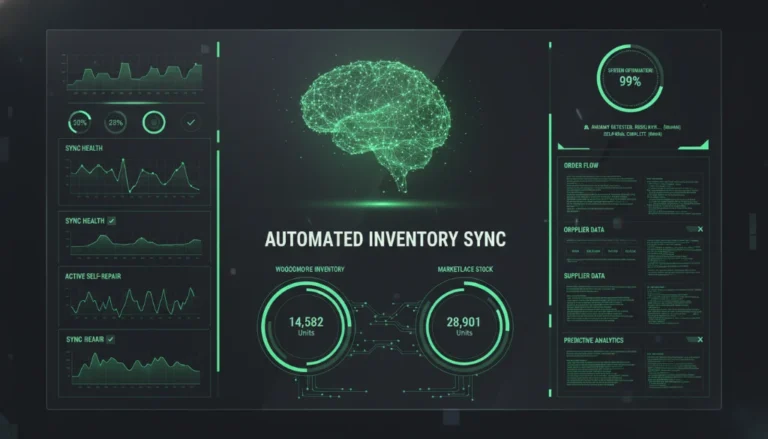
Hyper-automation for small stores with automated inventory sync

Hyper-Automation for Small Stores: 5 Smart Wins

Hyper-automation for small stores is redefining how independent retailers manage inventory, pricing, and order synchronization across WooCommerce and multiple marketplaces. Small ecommerce businesses often struggle with manual stock updates, listing inconsistencies, and overselling. Hyper-automation introduces intelligent systems that detect errors, auto-correct discrepancies, and maintain real-time synchronization without constant manual intervention. In a multi-channel environment where […]

Read More
Business Automation Architecture enterprise transformation

Business Automation Architecture: 7 Scalable Gains

Business Automation Architecture is no longer an operational enhancement—it is a strategic enterprise foundation. Modern organizations require automation systems that are structurally integrated into business models, governance frameworks, and digital infrastructure. Automation today defines scalability, resilience, and long-term competitiveness. Enterprises that treat automation as isolated tooling fail to achieve transformation. True automation architecture redesigns workflows, […]

Read More
Enterprise AI governance frameworks for scalable AI adoption

5 Powerful Enterprise AI Governance Frameworks

5 Powerful Enterprise AI Governance Frameworks Enterprise AI governance frameworks are becoming essential as organizations scale artificial intelligence across business operations, customer platforms, and decision systems. Without governance, AI creates operational risk, compliance exposure, and ethical uncertainty. Enterprises must move beyond experimentation and adopt structured governance models that ensure control, trust, and accountability. As AI […]

Read More
Why AI agents are replacing traditional automation in enterprises

Why AI Agents Are Replacing Traditional Automation

AI agents replacing automation marks a major shift in how enterprises design intelligent systems. Traditional automation relied on predefined rules and static workflows. AI agents introduce autonomy, reasoning, and adaptability, allowing systems to operate dynamically in complex and changing environments. As enterprises scale digital operations, rule-based automation increasingly fails to keep pace with real-world complexity. […]

Read More
AI operating models powering scalable growth in enterprises

6 AI Operating Models Powering Scalable Growth

Artificial intelligence has moved from experimentation to enterprise-wide deployment. However, technology alone does not deliver scale. The way AI is organized, governed, and embedded into business operations determines whether it becomes a growth engine or a bottleneck. Understanding the AI operating models powering scalable growth is critical for enterprises aiming to industrialize AI responsibly and […]

Read More
Why AI is becoming essential in modern medicine across hospitals

Why AI Is Becoming Essential in Modern Medicine

Artificial intelligence is no longer a peripheral technology in healthcare. It has become a foundational capability that shapes how clinicians diagnose disease, how hospitals operate, and how patients experience care. Understanding why AI is becoming essential in modern medicine is critical for healthcare leaders seeking to deliver better outcomes while managing rising costs and operational […]

Read More
AI use cases improving patient outcomes in modern healthcare

6 AI Use Cases Improving Patient Outcomes

Artificial intelligence is no longer an experimental technology in healthcare. It is becoming a core clinical and operational capability that directly influences quality of care. Understanding the AI use cases improving patient outcomes is essential for hospitals, health systems, and digital health providers seeking measurable gains in accuracy, safety, and efficiency. From diagnostics to long-term […]

Read More
Human-in-the-loop AI use cases in enterprise environments

7 Human-in-the-Loop AI Use Cases

Human-in-the-loop AI represents a powerful approach to building intelligent systems that remain accurate, ethical, and reliable at scale. Instead of operating in isolation, AI systems continuously receive feedback, corrections, and oversight from human experts. Understanding the human-in-the-loop AI use cases shaping modern enterprises is essential for organizations deploying AI in high-impact environments. From healthcare to […]

Read More
Critical cybersecurity trends enterprises face in 2026

5 Critical Cybersecurity Trends Enterprises Face in 2026

Cybersecurity is entering a new era of complexity. As enterprises expand across cloud platforms, remote work environments, and connected devices, digital risk is growing faster than traditional security models can handle. Understanding the critical cybersecurity trends enterprises face in 2026 is essential for protecting data, infrastructure, and business continuity. Attackers are becoming more sophisticated, leveraging […]

Read More

7 Critical Methods AI Uses to Learn From Humans

The critical methods AI uses to learn from humans ensure accuracy, fairness, and reliability in real-world applications. Without the critical methods AI uses to learn from humans, enterprise AI systems would lack trust and consistency. Artificial intelligence does not evolve in isolation. Every intelligent system is shaped, refined, and guided by human knowledge, decisions, and […]

Read More