
Enterprise Digital Infrastructure is now the foundation of modern business competitiveness. It defines how organizations scale, secure operations, manage data, and sustain innovation. Infrastructure is no longer a backend IT function; it is a strategic business asset that directly impacts enterprise performance, agility, and market leadership.
Enterprises operating on fragmented or legacy systems face increasing operational risk, rising costs, and declining responsiveness. Digital infrastructure today must be intelligent, integrated, and architected for continuous evolution. For CXOs and founders, infrastructure strategy is enterprise strategy.
Enterprise Digital Infrastructure as Strategic Core
Enterprise Digital Infrastructure integrates cloud platforms, data architecture, automation systems, cybersecurity frameworks, and enterprise applications into a unified operational foundation. This creates a scalable and resilient digital backbone that supports every business function.
Without architectural alignment, digital investments create complexity instead of capability. Strategic infrastructure design ensures that technology directly enables business objectives rather than operating as isolated systems.
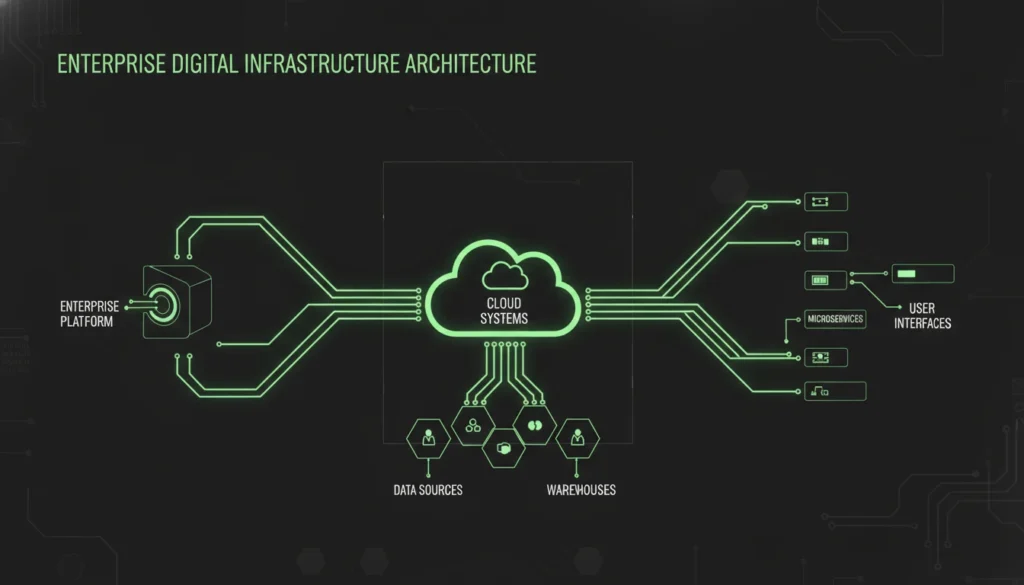
7 Future-Proof Gains from Enterprise Digital Infrastructure
- Scalable Growth Enablement: Digital infrastructure allows enterprises to expand operations without proportional increases in cost or complexity.
- Operational Resilience: Redundant systems, cloud resilience, and automated recovery frameworks reduce business disruption risk.
- Data-Driven Intelligence: Integrated data platforms enable real-time insights and predictive decision-making.
- Security by Architecture: Embedded cybersecurity frameworks protect enterprise assets at every operational layer.
- Innovation Velocity: Modular infrastructure accelerates product development and service deployment cycles.
- Cost Optimization: Cloud-native and automated systems improve capital efficiency and operational expenditure control.
- Competitive Differentiation: Enterprises with modern infrastructure outperform competitors in speed, reliability, and adaptability.
Designing Infrastructure for Scale
Future-ready infrastructure begins with enterprise architecture planning. This includes cloud strategy, data governance, application modernization, and integration frameworks.
Enterprises must design infrastructure as an adaptive platform that evolves with business needs. Static systems become liabilities in dynamic markets. Scalable infrastructure is modular, interoperable, and intelligence-enabled.
Governance, Security, and Compliance Layers
Enterprise Digital Infrastructure must embed governance at the architectural level. Security frameworks, compliance controls, access management, and monitoring systems are core design components, not add-ons.
Organizations that integrate governance into infrastructure design achieve higher trust, regulatory readiness, and operational stability.

Transformation Enablement and Strategic Alignment
Infrastructure transformation requires organizational alignment across leadership, IT, operations, and business strategy. Technology modernization without business alignment creates execution risk.
Enterprises that follow structured digital transformation models accelerate infrastructure maturity and reduce transformation failure rates.
Explore enterprise transformation leadership and digital strategy frameworks at https://dbsofttech.com/about-us/
Global enterprise research supports infrastructure-led transformation. According to Gartner’s enterprise infrastructure insights, digital infrastructure modernization is a primary driver of business resilience and competitiveness. https://www.gartner.com/en/information-technology/insights
Building the Future Enterprise
Enterprise Digital Infrastructure is not a technology upgrade—it is a strategic transformation. Enterprises that delay modernization face structural inefficiencies, security vulnerabilities, and declining competitiveness.
Organizations that invest in future-ready digital infrastructure build adaptive enterprises capable of sustained growth, innovation leadership, and long-term market relevance.